

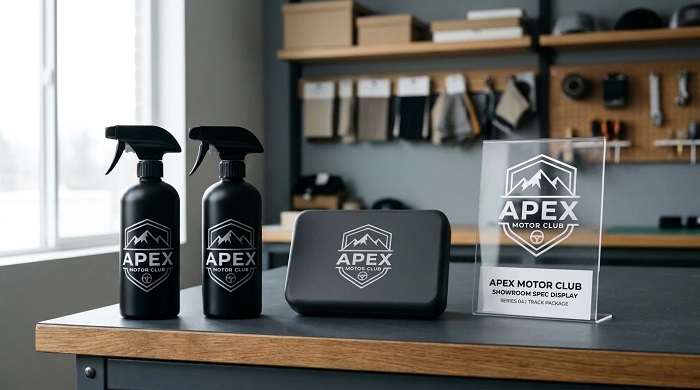
Automotive detailing studios, tuning workshops, dealership service departments, and regional car clubs buy a steady stream of branded rigid merchandise: refilled chemical spray bottles, hard-shell key-fob presentation boxes, acrylic showroom specification stands, insulated shop tumblers, and indoor display plaques. For print shops supplying that market, roll-to-roll UV DTF (ultraviolet direct-to-film) transfers offer a fast way to decorate small batches of hard goods without building flatbed jigs or paying screen-setup fees.
At the same time, automotive buyers frequently ask a question that print shops must answer honestly before quoting: “Can we stick these same UV DTF decals on the outside of a customer’s car, bumper, or alloy wheel?” Drawing a clear technical boundary between indoor/showroom hard goods and exterior vehicle body graphics protects both the workshop’s brand and the print shop’s warranty reputation.
Where UV DTF Delivers Real Value for Automotive Businesses
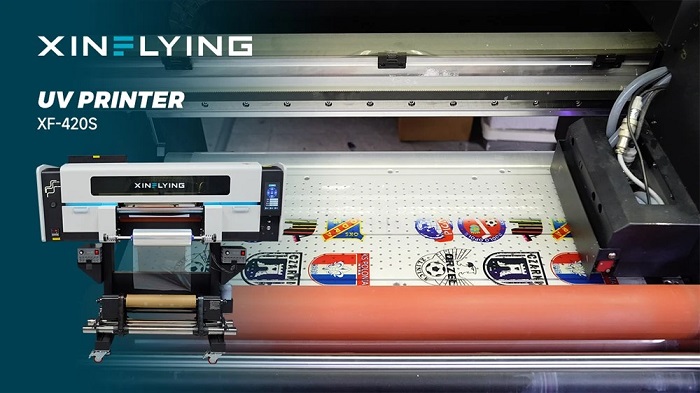
Standard rigid UV DTF prints UV-cured white, CMYK, and clear varnish layers onto an adhesive release film (A-film) and laminates them with a transfer carrier (B-film) for hand application. Because the object never enters the printer, a sign or print shop can gang-run emblems for several automotive accounts on one roll and apply them directly to odd-shaped rigid items.
The highest-value automotive applications stay inside the showroom, workshop, or customer handover pack:
- Detailing and chemical bottles: Small detailing studios often bottle house-branded interior cleaners or ceramic-maintenance sprays in rigid HDPE or PET spray bottles. UV DTF lets them test fifty bottles with crisp, multi-colour graphics before committing to industrial label runs—provided the specific bottle plastic is checked for adhesion and solvent resistance against the liquid inside.
- Dealership handover and VIP merchandise: Matte-black hard-shell key-fob boxes, insulated stainless-steel travel mugs, and rigid tool-case badges benefit from sharp white-underbase contrast and a thin, raised varnish sheen.
- Showroom displays and club plaques: Clear acrylic spec cards, indoor metal wall plaques, and display stands accept pressure-sensitive transfers cleanly on flat, dust-free surfaces.
Why Exterior Automotive Body Panels Belong to Cast Vinyl
Exterior vehicle surfaces endure a combination of stresses that standard rigid UV DTF crystal labels are not engineered to survive over multi-year use:
| Exposure Stress | Automotive Exterior Reality | Practical Process Boundary |
|---|---|---|
| High-pressure washing & road grit | Direct water jets and gravel impacts catch raised ink edges | Cast automotive wrap vinyl with matching overlaminate sits thinner and conforms tightly |
| Compound curves & panel recesses | Bumpers, mirrors, and fenders require heat-stretchable conformability | Standard rigid UV DTF film is non-conformable and bridges or lifts on tight compound curves |
| Thermal cycling, fuel & UV exposure | Hoods and fenders swing from freezing winter air to intense engine/sun heat | Exterior automotive decals require purpose-rated outdoor vinyl and adhesive systems |
Promising a car club that ordinary rigid crystal labels will last for years on a rear bumper or exposed motorcycle fairing invites premature edge lifting and avoidable returns. Positioning UV DTF accurately for showroom, cabin-adjacent, and promotional hard goods—while keeping exterior body graphics in cast vinyl—builds far stronger repeat trust with automotive managers.
Surface Prep Rules for Oily Workshop Environments
Automotive shops are full of silicone dressings, tire shine, wax, and airborne polish mist. Even an invisible film of silicone residue on a plastic spray bottle or coated metal flask will prevent pressure-sensitive UV DTF adhesive from bonding.
Before applying transfers to automotive merchandise, print operators should wipe each rigid item with a clean lint-free cloth and suitable surface cleaner (such as isopropyl alcohol, tested first so it does not craze clear acrylic), handle the blank by its edges, and burnish firmly from the centre outward before peeling the B-film slowly at a low angle.
Print service providers expanding into custom hard-goods merchandising for dealerships, detailing brands, and automotive clubs can review commercial UV DTF printers from XINFLYING to match roll width and inline lamination stability to their regular B2B order volume.
When an automotive client requests custom branding across both vehicles and showroom merchandise, split the quote cleanly: keep exterior body graphics in automotive-grade vinyl, and route their rigid bottles, key boxes, drinkware, and indoor displays through UV DTF after testing one sample of each blank.