

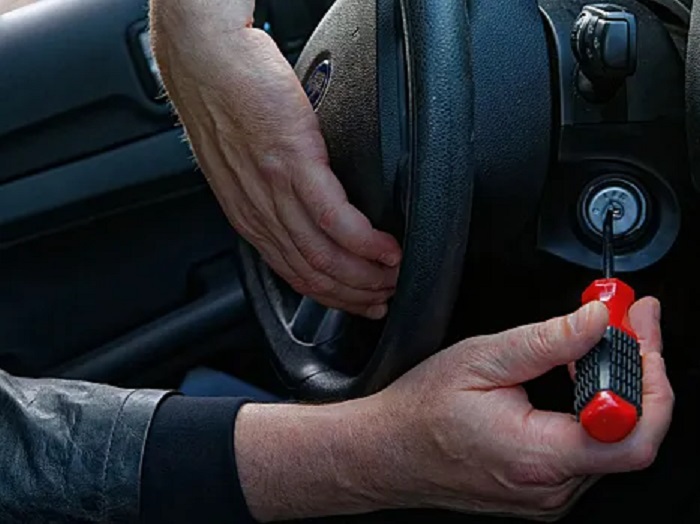
A broken key in the ignition or door cylinder is an unpleasant situation, but can often be resolved without serious consequences if handled carefully. The main mistake is trying to force the broken key out or pry it out with unsuitable objects, damaging the cylinder and complicating the repair.
Follow these steps: assess the location of the break, secure the steering wheel and selector, eliminate the risk of short-circuiting, and choose a safe removal method with Richmond Hill locksmith. Below are practical options for different situations.
First steps and assessing the situation
1) Do not make the break worse. Stop turning the key and do not press on the broken key. If the key broke in the ignition, make sure the steering wheel isn’t jammed.
2) Determine where the broken piece is located. Possible locations: in the door lock, in the trunk lock, in the ignition lock, in the key fob/flip mechanism (not in the cylinder).
3) Check to see if part of the key is sticking out. If at least 2–3 mm is sticking out, the chances of removing it without disassembling it are much higher.
4) Prepare the conditions. Provide lighting, park the car in a safe place, and turn on the hazard lights. If the fragment is in the ignition and the car is running, assess whether you can drive it to a service center (sometimes the fragment holds the contact group, but this is risky).
If part of the key is sticking out of the lock
The safest option is to remove it by the protruding part. Fine-nosed pliers or tweezers will work, but pull strictly along the key’s axis, without rocking it.
- Stop your hand to prevent it from jerking to the side and chipping the edges of the cylinder.
- Don’t squeeze too hard to avoid crushing the metal and breaking off the protrusion.
- Slight rocking is acceptable only within the axis (back and forth), without turning.
Useful: if the lock is dry or “sedated,” you can apply a drop of graphite lubricant or a specialized lock compound. Avoid using thick oils: they collect dust and impair the mechanism’s operation.
If the fragment is recessed and there’s nothing to grab onto
Do not use screwdrivers, awls, or knives. They usually stretch the pins, scratch the channels, and cause the cylinder to be replaced.
- Thin extractor/hook. Special key extractors or a thin steel plate with a hook will do. Insert the tool along the key groove and try to pry the fragment out by pulling it along the axis.
- Two thin plates. If you have two narrow plates (for example, from a feeler gauge/blank), you can insert them along the sides of the fragment, press lightly, and pull outward.
- Glue – only as a last resort. Attempting to glue the rod to the fragment often results in glue getting into the cylinder and blocking the pins. It is best to avoid this method.
If the fragment is in the ignition switch and the steering wheel is locked, first relieve the load on the lock: slightly turn the steering wheel toward the freewheel and simultaneously try to remove it. Don’t try to turn the cylinder by force.
How to assess the location of the failure: door lock, ignition cylinder, or key fob
First, determine the exact location of the failure: the mechanical door lock, the ignition cylinder, or the key fob/remote control (if the key is “smart”). This will determine whether a spare key is sufficient, whether the fragment will need to be removed, or whether an electronic diagnostic will be required.
Start your assessment with simple signs: what’s left in your hands, what’s left in the lock, is there a click/turn, does the car respond to the buttons, and does the key recognize the key. If in doubt, it’s best not to use force: repeated attempts often push the fragment deeper and complicate removal.
Quick diagnosis by signs
- Door lock: the fragment remains in the door cylinder; The key stops turning or turns “idle”; other doors can be opened with the key fob/central locking system, but this particular door cannot.
- Ignition Cylinder: There is a fragment in the ignition switch; the steering wheel may be locked; the key does not turn from the LOCK position; the instrument panel does not turn on or turns on, but starting is impossible due to inability to turn fully.
- Key Fob/Smart Key: The mechanical part of the key is intact or not used at all, but remote opening does not work; the car does not detect the key (Key not detected message); The Start/Stop button prevents the engine from starting.
- If the door is broken, first ensure access to the interior with a spare key or through a working door, then address the issue of removing the broken piece and servicing the lock.
- If the ignition is broken, do not completely block the situation: stop turning, assess the position of the steering wheel, and seek help if the broken piece is deep and access is limited.
- If the problem is with the key fob, check a spare key, battery, and emergency start/unlock capability according to the vehicle’s manual.
Summary: The location of the failure is determined by where the fragment is stuck and which component has stopped functioning: the door (access), ignition (turn and start), and the key fob (communication and key recognition). An accurate initial assessment saves time and reduces the risk of damaging the lock or electronics during subsequent operations.