

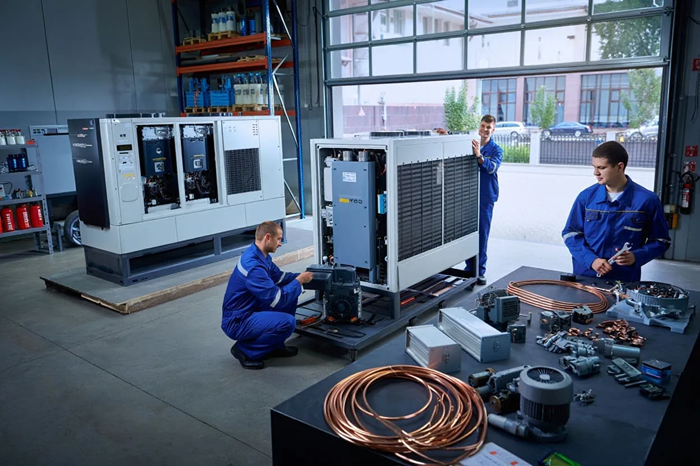
The installation of commercial refrigeration equipment determines not only temperature stability but also the service life of compressors, personnel safety, and overall operating costs. Start-up errors lead to refrigerant leaks, evaporator freezing, increased energy consumption, and product storage failures.
Proper installation from LArefrigeration is based on compliance with manufacturer requirements, sanitary standards, and electrical safety regulations, as well as accurate load calculations and proper commissioning. Below are practical rules and a workflow that will help achieve predictable results.
Key Installation Rules
1) Compliance with the design and operating conditions. Before installation, confirm the intended use of the cabinet/display case (meat, milk, frozen food), the required temperature range, and the actual heat input (frequency of door openings, lighting, number of people, and the arrival of warm goods).
2) Room preparation. Check the evenness of the floor, the strength of the foundation, the presence of drainage/sewerage (if required), ventilation, and the absence of nearby heat sources (stoves, air curtains, direct sunlight). It is important to provide service clearances for access to the unit and condenser.
3) Power supply and protection. A separate line with the correct cable cross-section, circuit breakers, and RCDs rated for the rated power, is installed. Grounding is mandatory, and the quality of the contacts and the absence of overheating in the terminal connections are checked.
4) The tightness and cleanliness of the refrigeration circuit. The pipelines must be free of kinks, strain, and vibration loads. Connections must be made using soldering/press-fitting technology, with inert gas purging (where required) to prevent carbon deposits and contamination within the line.
5) Compliance with heat dissipation requirements. The condenser requires adequate airflow and free exhaust of the heat flow. Clogging, close proximity to a wall, and lack of circulation are common causes of overheating, pressure buildup, and emergency shutdowns.
Typical Mistakes to Avoid
- Installation close to walls without service access or ventilation gaps;
- Connection to a “common” outlet without a dedicated line and protection;
- Incorrect drain line slope, leading to leaks and odors;
- Startup without vacuuming and leak testing;
- Incorrect controller settings (hysteresis, defrost, emergency thresholds).
Selecting a location considering ventilation, heat gain, and personnel traffic
The installation location of commercial refrigeration equipment determines temperature stability, energy consumption, and compressor life. Errors at this stage lead to condenser overheating, frequent protection shutdowns, and increased maintenance costs.
Before installation, evaluate ventilation, external heat gain, and work aisle organization to ensure normal heat exchange and safe operation. Provide access for service work and prevent personnel flows from interfering with unloading, cleaning, and door opening areas.
Key Installation Site Requirements
- Ventilation and Heat Removal: Ensure free air flow and exhaust around the condenser/grilles; do not obstruct ventilation areas with boxes, packaging, or racks; keep in mind that recirculating warm air significantly reduces cooling efficiency.
- Minimize Heat Gains: Avoid placing equipment near stoves, combi steamers, deep fryers, heated display cases, radiators, or in direct sunlight. Avoid installation near frequently opened gates/doors where warm air curtains and drafts are possible.
- Personnel passages and logistics: Position the door/lid so that it opens fully and does not block the passage; leave space for carts and loading; avoid dangerous “blind” turns and intersections with hot areas.
- Maintenance accessibility: Provide access to the unit compartment, filters/grilles, drainage, shut-off valves, and connection points; Maintenance must be performed without dismantling adjacent equipment.
- Foundation and surroundings: level, rigid surface, no vibration loads, protection from moisture and the ingress of cleaning solutions into electrical components and ventilation openings.
- Measure the actual clearances around the equipment and ensure that ventilation zones do not overlap.
- Assess the thermal environment: heat sources, sun, proximity of doors, and traffic intensity.
- Simulate work routes (loading, unloading, cleaning) and verify safe door opening and cart movement.
- Ensure service accessibility and the ability to clean the condenser without dismantling the area.
Result: A properly selected location with adequate ventilation, minimal heat gain, and convenient personnel access ensures stable operation of refrigeration equipment, reduces energy consumption, and reduces the risk of accidents and downtime.